
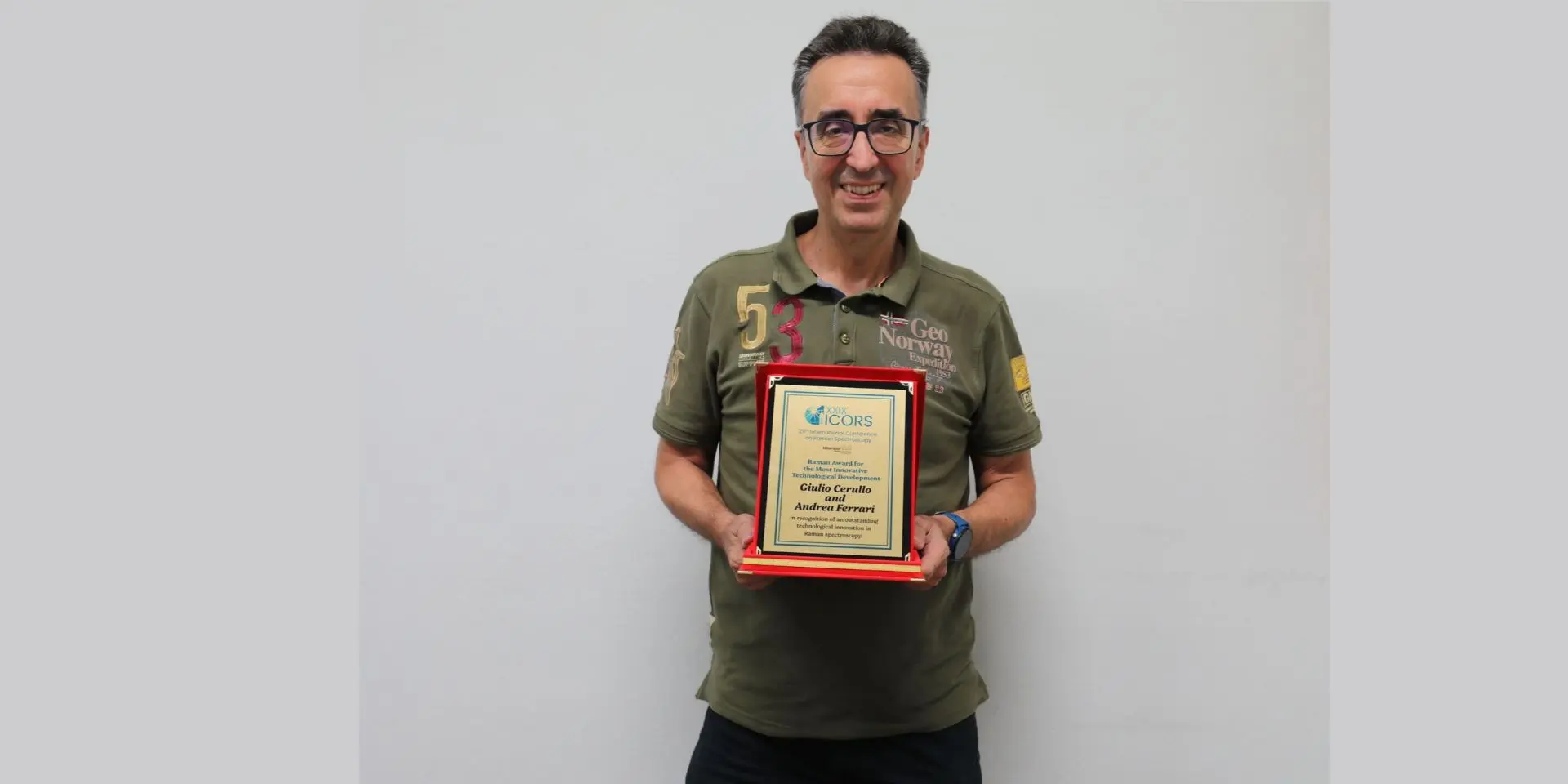
Giulio Cerullo, a professor in the Department of Physics, was honoured at the 29th International Conference on Raman Spectroscopy (ICORS 2026), which took place in Istanbul.
The Raman Award recognises the development of a new technology that could facilitate the transition of advanced Raman imaging from specialised research laboratories to practical applications in the healthcare, industrial and environmental sectors. The technology in question comprises passively synchronised fibre lasers for broadband stimulated Raman scattering (SRS) spectromicroscopy.
The award was also presented to Andrea C. Ferrari, a professor at the University of Cambridge, with whom Cerullo collaborated on the development of the technology.
At the heart of the technology lies a compact fibre-optic laser architecture, designed to ensure the spectral bandwidth and synchronisation required for broadband SRS microscopy. The system is stable and requires no alignment. Combining it with a high-frequency, 100-channel detection system enables the creation of a compact SRS microscope capable of rapidly producing detailed chemical maps of cells and tissues.
This achievement could pave the way for new applications, including biomedical imaging, digital pathology, pharmaceutical analysis and environmental monitoring of microplastics.
The first pilot trials were carried out at Jena University Hospital, whilst commercial development is being led by Cambridge Raman Imaging Ltd. (CRIL).
This award-winning new technology demonstrates how fundamental advances in laser and spectroscopic technology can be translated into practical tools with the potential to make an impact in the fields of healthcare, manufacturing, the pharmaceutical industry and environmental sciences.