
Matteo Lucchini, a professor in the Department of Physics and an associate at CNR-IFN, is the principal investigator of a study published in Nature Photonics.
Driven by the need to increase the speed and performance of electronic devices, the research has demonstrated how doping enables the control of semiconductors’ interaction with ultra-short light pulses, opening up new prospects for the development of optoelectronic technologies directly driven by light.
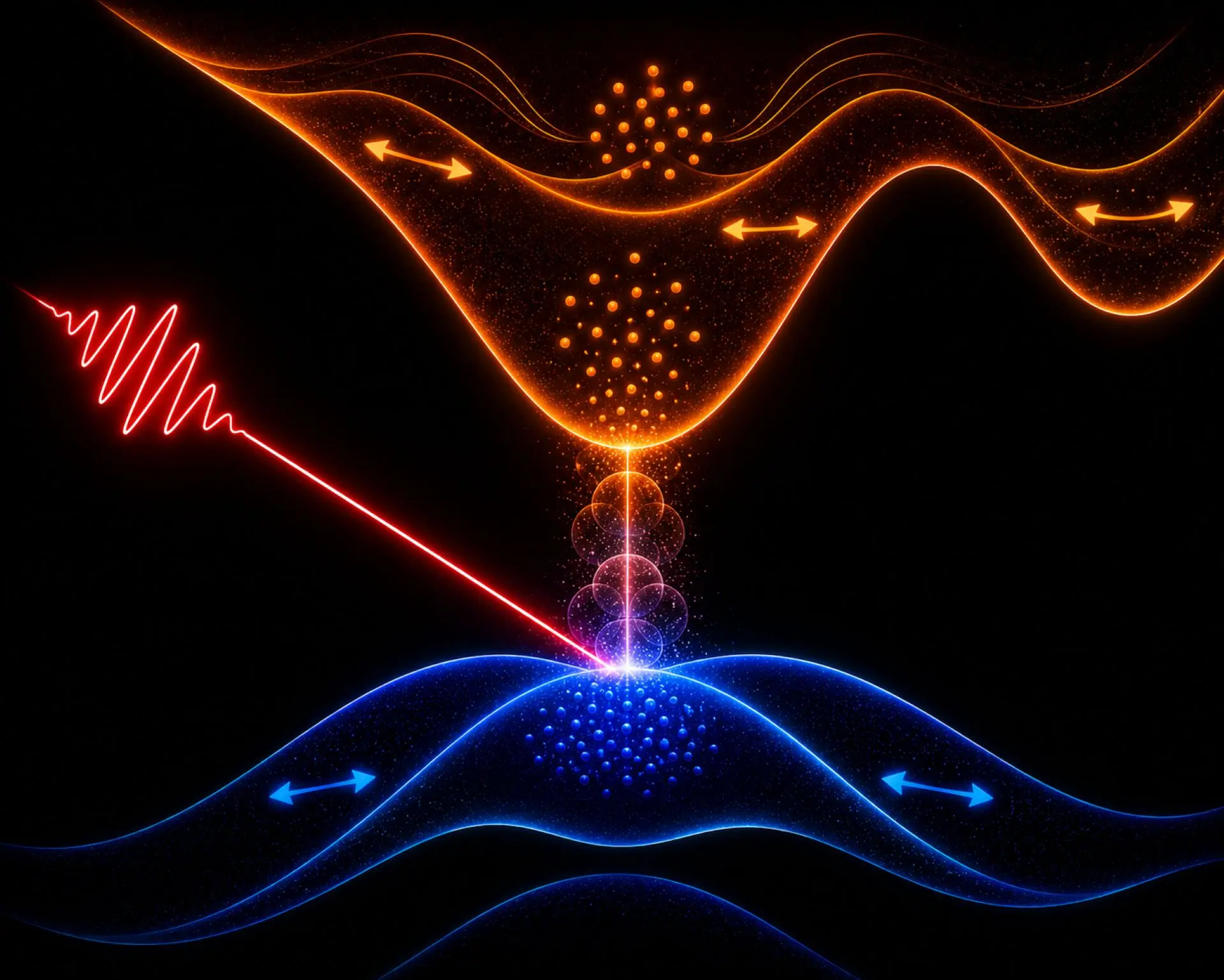
Using an advanced transient reflection spectroscopy technique, capable of observing processes occurring on attosecond timescales, the research team analysed the light-induced electronic dynamics in doped single-crystal germanium, measuring how doping influences the time delay between the radiation and the material’s optical response.
By comparing samples with different doping levels, two distinct regimes of light–matter interaction were identified: at low impurity levels, the dynamics are dominated by the light-induced charge injection process; at higher doping concentrations, however, the electrons present in the material alter these dynamics, favouring the intra-band motion of virtual charges, which exist only during interaction with the light field.
The study also demonstrates that it is possible to achieve, even in highly conductive materials, an optical response a thousand times faster than that of conventional electronics, opening up new prospects for the development of ultra-fast optoelectronic devices.
The work was carried out at the Attosecond Research Centre (ARC) at the Politecnico di Milano, as part of the European and national projects ERC AuDACE (Attosecond Dynamics in AdvanCed matErials) and MIUR FARE PHorTUNA (PHase Transition Ultrafast dyNAmics in Mott insulators).
The research involved collaboration with the Universities of Salerno and Padua, the University of Tsukuba, the Max Planck Institute for the Structure and Dynamics of Matter, and the Institutes of Photonics and Nanotechnologies (CNR-IFN), Microelectronics and Microsystems (CNR-IMM), and Superconductors, Innovative Materials and Devices (CNR-SPIN) of the National Research Council.