
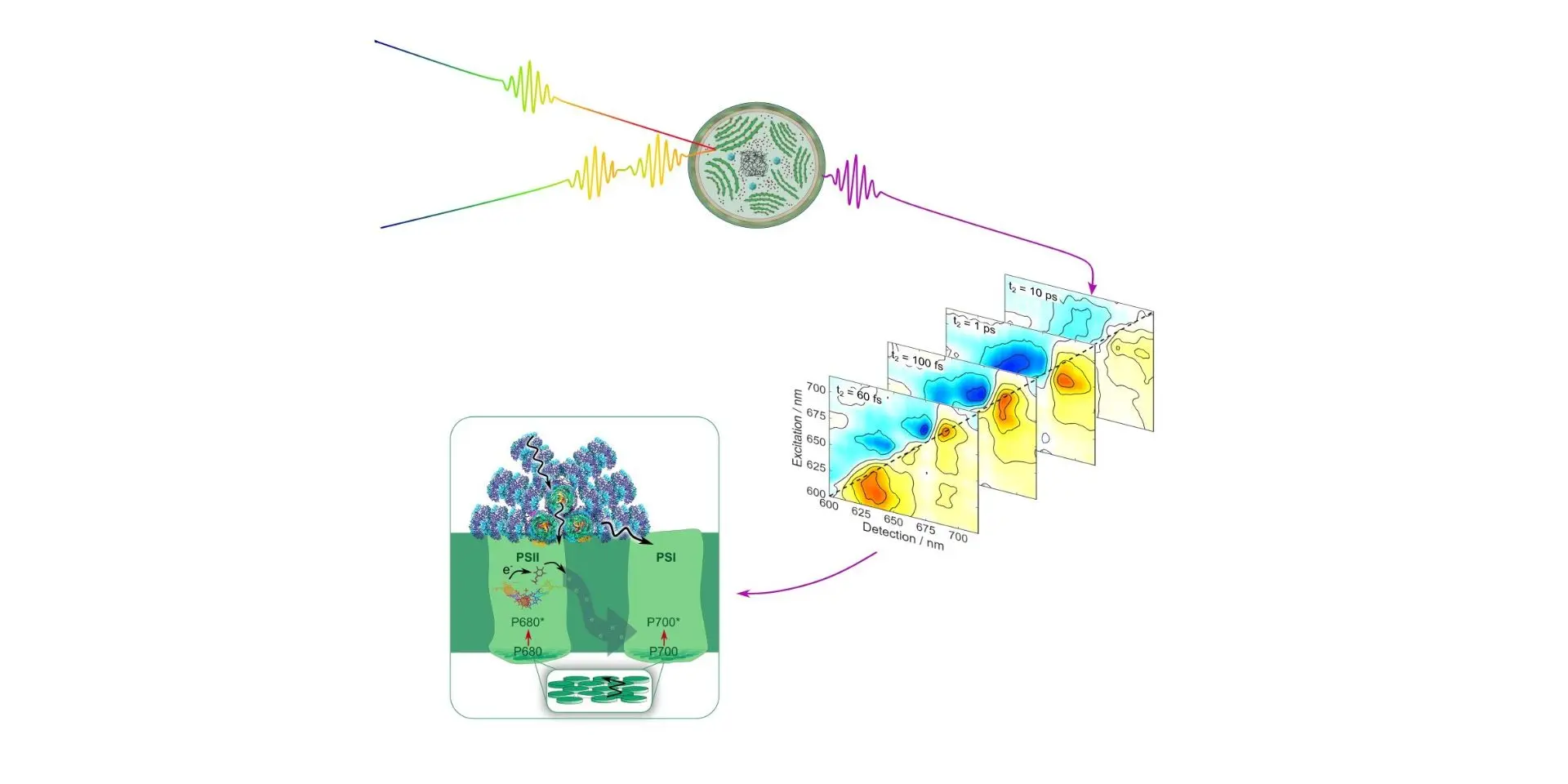
Rhea Kumar, Giulio Cerullo and Margherita Maiuri from the Department of Physics at Politecnico di Milano, together with collaborators at the National Research Council (CNR), have demonstrated an ultrafast spectroscopic approach capable of following the earliest steps of photosynthesis directly in living cells and under physiological conditions.
By combining femtosecond transient absorption spectroscopy and Two-Dimensional Electronic Spectroscopy (2DES), the researchers followed the journey of energy through the photosynthetic machinery of the cyanobacterium Synechocystis: from light harvesting and energy transfer to the reaction centres, to charge separation and electron transport between photosystems II and I.
The study brings ultrafast spectroscopy beyond isolated photosynthetic complexes, allowing these fundamental processes to be investigated within their native cellular environment while the photosynthetic machinery is functionally active. This opens new possibilities for studying how photosynthesis adapts and responds to changing environmental conditions.
The results may also provide new insights for the development of artificial and biohybrid light-harvesting systems inspired by the efficiency, robustness and adaptability of natural photosynthesis.
The study, carried out by researchers at Politecnico di Milano in collaboration with the National Research Council (CNR), has been published in Chem.