
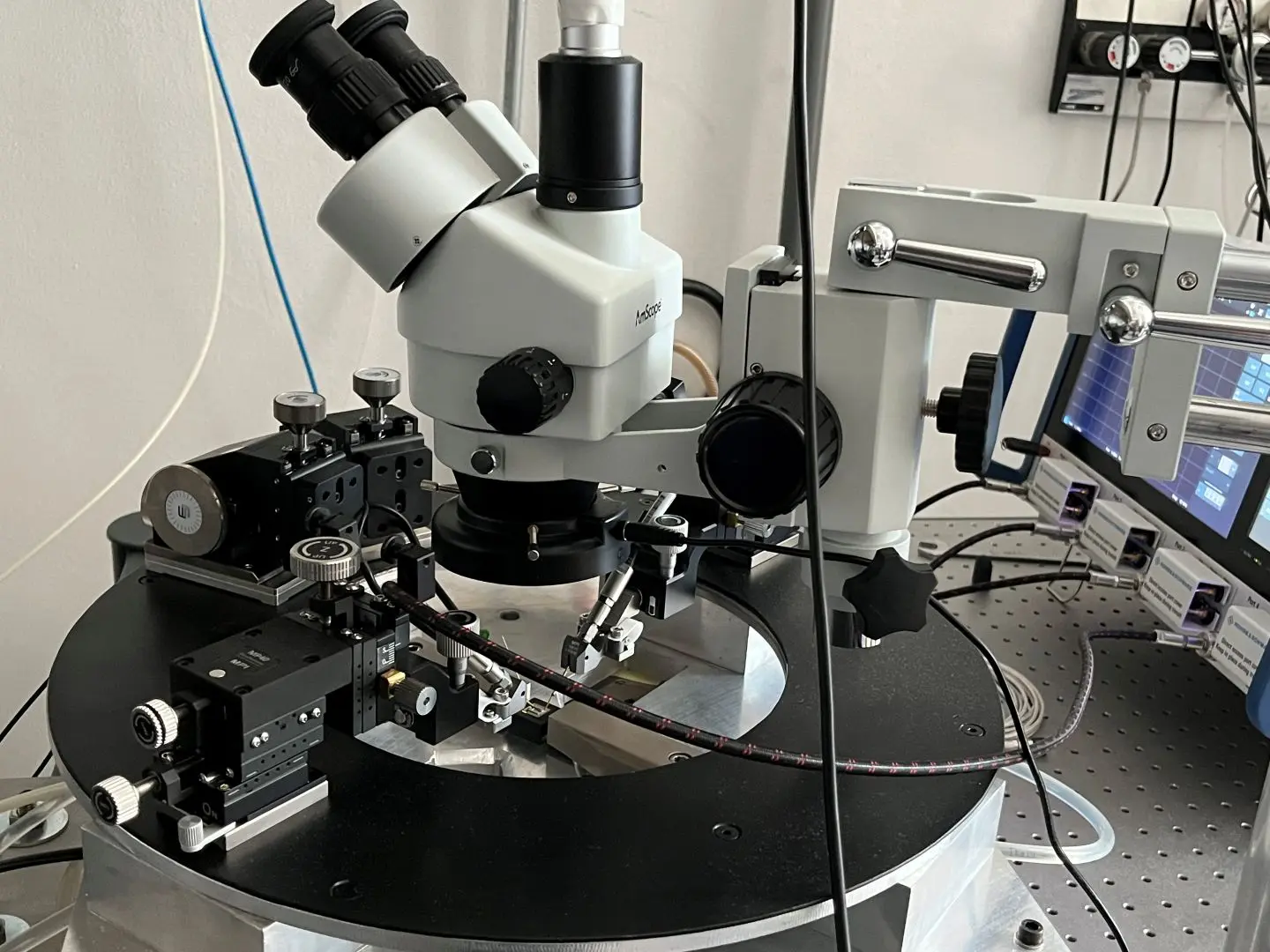
The first integrated silicon microchip capable of using spin waves has been developed. This result, achieved by a group of researchers at the Politecnico di Milano, including Riccardo Bertacco, professor in the Department of Physics, and published in Advanced Materials, represents an important step forward in the use of spin waves for future telecommunications.
Study and results obtained
The technology is based on magnonics, an emerging field that uses spin waves as an alternative to electrical signals. In the past, the integration of these devices into chips was limited by the need for an external magnetic field. The new prototype overcomes this constraint thanks to an innovative combination of permanent SmCo micromagnets and magnetic flux concentrators, which allows completely autonomous operation.
The chip, which is extremely miniaturised compared to current RF devices (100×150 square micrometres), is compatible with existing electronic platforms. By varying the distance between magnets and concentrators, researchers can precisely modulate the magnetic field and adjust the operating frequency between 3 and 8 GHz, achieving a phase shift of up to 120 degrees at 6 GHz in this first prototype.
The prototypes also function as delay lines and phase shifters without the use of external magnetic fields.
Objective
The study aims to create a technological platform capable of making communication devices more efficient, compact and reconfigurable, paving the way for new applications in telecommunications and high-frequency electronics.
The work is part of the European MandMEMS project, funded by Horizon Europe, which involves several European research centres and industrial partners, with expertise ranging from magnonics to MEMS, from radio frequency electronics to materials science.