
The department
The Department of Physics was established with the aim of conducting experimental and theoretical scientific research in the field of the Physics of Matter and contributing to the development of applications of this field in Physics, Engineering and Medicine.
History of the Department
Ever since the Politecnico di Milano was founded in 1863, physics has been a fundamental discipline in the training of engineers, contributing to the development of a scientific culture focused on technological innovation and dialogue with the industrial sector.
The current Department of Physics, which grew out of the Institute of Physics founded in 1930, brings together research and teaching activities in the field of the physics of matter. Over the years, it has developed a distinctive identity, combining experimental and theoretical research and promoting applications in the fields of engineering, photonics, materials science, optics and medical physics.
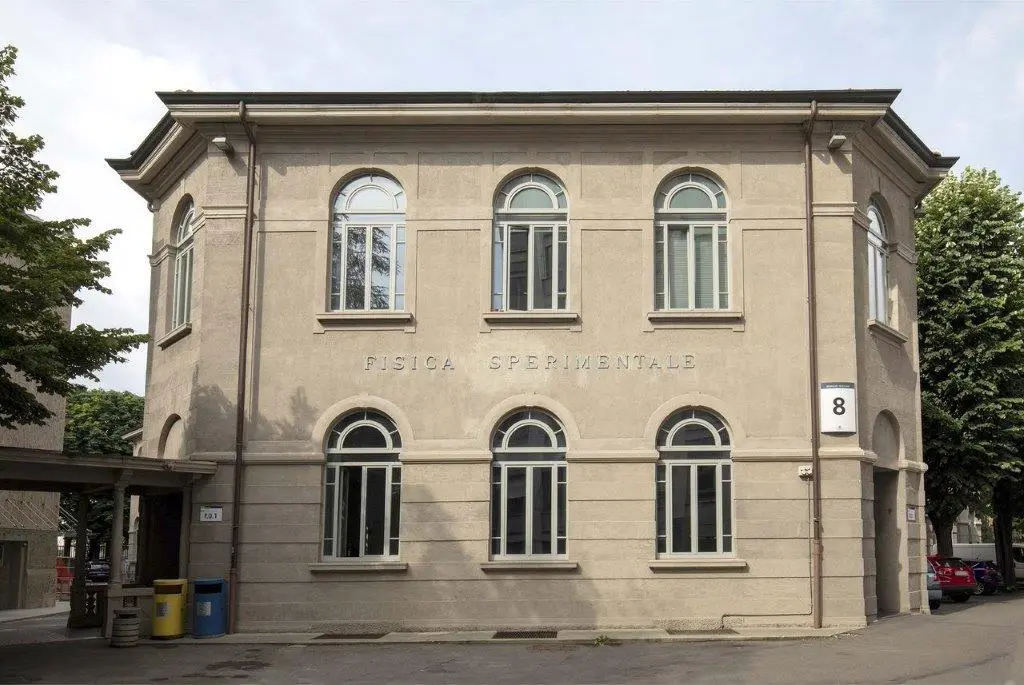
The Department is based in Building 8, named after Alessandro Amerio (1876–1965), a professor of experimental physics. During his studies on atmospheric radiation, he devised the Pireliometer, which bears his name, and, in the mid-1930s, he made a decisive contribution to the development of the Institute of Physics at the Politecnico di Milano, equipping it with a hydrogen liquefaction plant.
Translated with DeepL.com (free version)
Mission
The Department of Physics strives for excellence in scientific research in Applied Physics, with a primary focus on the Physics of Matter and Photonics. Research activities span a broad spectrum of the physical sciences, combining experimental and computational approaches to study both fundamental phenomena and their applications. A distinctive feature is its strong interdisciplinary focus, which takes the form of cross-departmental collaborations within the Politecnico and well-established partnerships with leading national and international research institutes.
The Department combines scientific rigour, a capacity for innovation and an openness to emerging technological challenges, maintaining a competitive profile on the international stage and contributing to the development of new knowledge and applications in the fields of physics and engineering.
Education is a central pillar of its mission. The Department offers a high-quality educational programme, from the three-year degree to the PhD, characterised by a solid scientific grounding, a strong experimental component and close integration between lectures, laboratory work and advanced research.
The Department is also committed to making a tangible impact on society through scientific dissemination, technology transfer, entrepreneurship and the promotion of applications with high social value, particularly in the fields of health, sustainability and enabling technologies. All this takes place within an inclusive, dynamic and international environment that fosters professional development and values the contribution of all members of the departmental community: teaching staff, researchers, technical and administrative staff, and students.
Values
For the Department of Physics, physics is a driving force for knowledge, innovation and social responsibility. Its values are centred on four fundamental principles.
Scientific rigour and excellence. Rigour characterises every area of activity: from fundamental research to experimental development, from teaching to technology transfer. This is reflected in the quality of the research and in the ability to develop cutting-edge tools, methods and technologies in the fields of Applied Physics, Physics of Matter and Photonics.
Experimental focus. The Department stands out for its advanced infrastructure and high-level experimental expertise, which constitute a strategic resource for research and training.
Interdisciplinarity and openness. Research is conducted in dialogue with other disciplines, through collaborations with networks, centres and major national and international infrastructures, and with growing involvement from the industrial and biomedical sectors.
Community and sharing. Laboratories, expertise and shared services are a collective asset. Collaboration and the development of people are essential conditions for sustainable scientific and organisational growth.
Areas of expertise
The areas of expertise of the Department of Physics reflect a strong integration between fundamental research, experimental development and advanced technological applications.
A first area concerns the generation of ultrashort pulses and their use in the study of matter on extreme time scales, down to the femtosecond and attosecond regimes, with applications to advanced materials, nanostructures, semiconductors and biological systems.
A second area of focus is dedicated to solid-state lasers and photonic devices for integrated systems, including coherent sources, frequency combs, photonic circuits, optofluidics, sensor technology and quantum technologies.
The Department also develops established expertise in photonics for healthcare, the agri-food sector and cultural heritage, through optical and spectroscopic techniques for non-invasive diagnostics, imaging, analysis of scattering media and the characterisation of biological, food and historical-artistic materials.
A further strategic area concerns epitaxial growth and the fabrication of nanostructures, with research focusing on semiconductors, magnetic materials, oxides, nanostructured devices and advanced lithographic techniques.
The fifth research area focuses on the electronic, optical and magnetic properties of low-dimensional systems, studied using spectroscopy, advanced microscopy, synchrotron radiation techniques, ultrafast photoemission and methods for the analysis of surfaces and interfaces. Taken together, these five research areas define a highly experimental and interdisciplinary scientific profile, capable of bridging the fields of condensed matter physics, photonics, nanotechnology, life sciences, quantum technologies and industrial applications.
Positions
Management
Coordinators

Director's delegates

Departmental Committee




Department Council
The Department Council is chaired by the Head of Department and consists of all the faculty members attached to the Department, the representative of doctoral students and representatives of the technical-administrative staff.