
How does a molecule’s configuration change the moment it absorbs light?
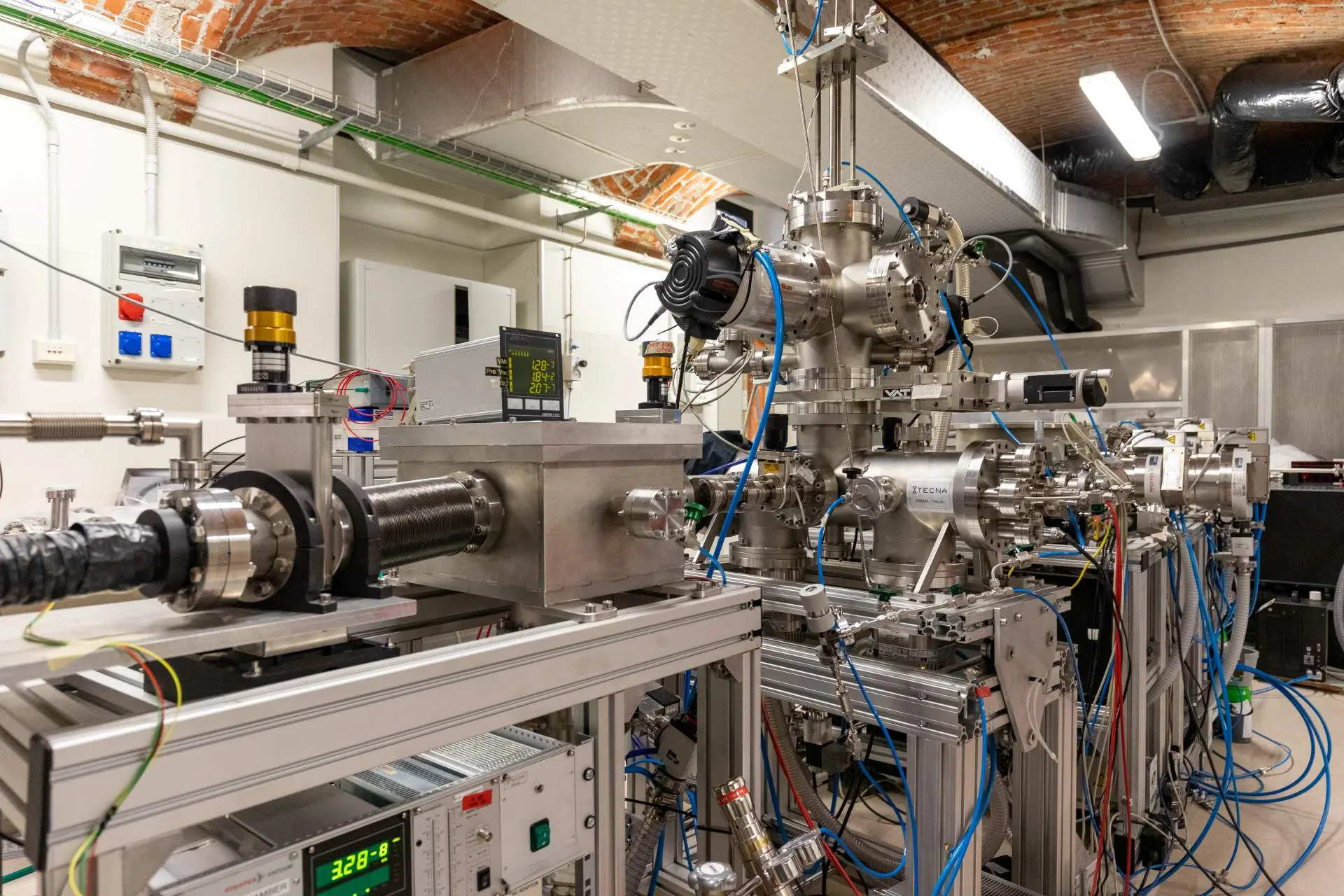
This is the subject of a study carried out by a group of researchers from the Department of Physics using a new experimental apparatus, developed by the group itself, capable of achieving a temporal resolution of approximately 3 femtoseconds – equivalent to three millionths of a billionth of a second.
The apparatus uses two short light pulses: the first, in the ultraviolet range, is absorbed by the molecule and triggers its evolution; the second, in the extreme ultraviolet range and lasting just a few attoseconds, allows the molecule’s state to be observed after a controllable time interval, reconstructing the various stages of the transformation. In particular, the instrument makes it possible to observe a molecule in the very first moments after light absorption, with a level of detail previously unattainable.
To test its capabilities, the researchers analysed the acetylacetone molecule, studying how the absorption of light causes a rapid redistribution of energy and the coordinated movement of electrons and nuclei.
The results were published in Nature Communications as part of the European ERC Synergy TOMATTO project, coordinated by Mauro Nisoli, Director and lecturer in the Department of Physics. Maurizio Reduzzi, an associate professor in the Department, contributed to the study in collaboration with the CNR Institute of Photonics and Nanotechnologies, Heriot-Watt University in Edinburgh and the University of Bologna.
The method can also be applied to other systems, ranging from molecules of biological interest to photoactive materials, and even to compounds involved in energy conversion processes. The ability to select the wavelength of the ultraviolet pulse also broadens the scope for studying photochemistry and actochemistry, a field of research that aims to understand and control the ultrafast processes of matter through the movement of electrons.