
Are we really alone in the universe?

It is a question we often ask ourselves, and one to which many researchers are seeking an answer. Basic research can, in fact, open up unexpected avenues and connect scientific fields that appear to be worlds apart.

Paolo Laporta, who graduated from the Politecnico di Milano in 1979 and is now a full professor of Experimental Physics, has dedicated his career to the study of lasers, going on to develop sophisticated optical frequency combs to observe planets light-years away. With the NIR AstroComb project, laser physics meets astrophysics and contributes to the search for new, potentially habitable worlds.
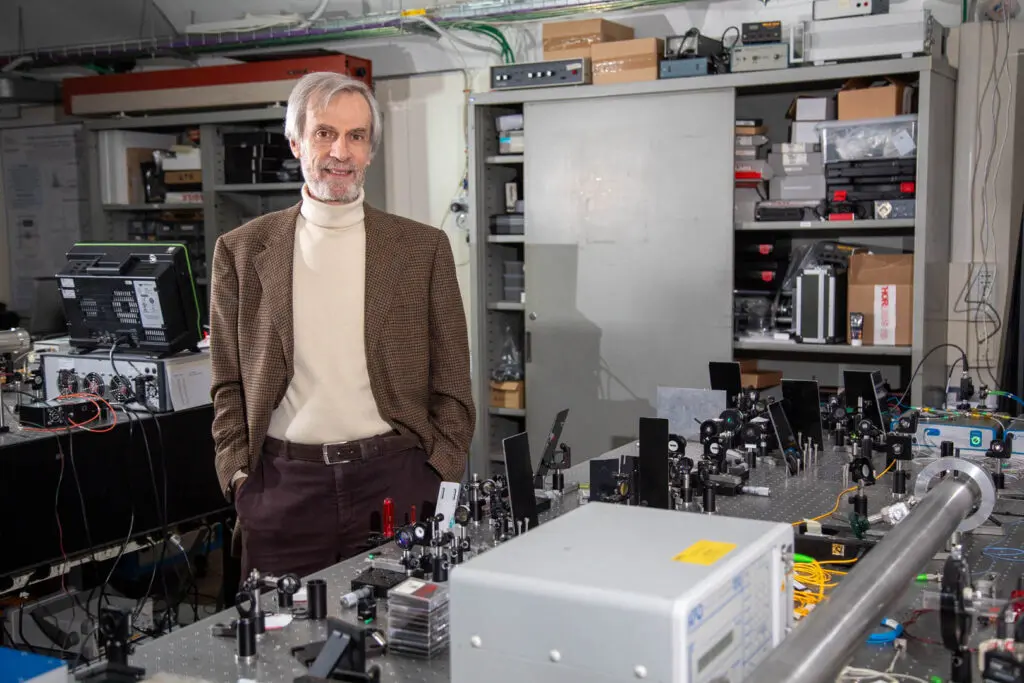
Paolo Laporta, Full Professor of Experimental Physics

The NIR AstroComb project

NIR AstroComb is the result of a joint effort between a team of researchers from the Department of Physics at the Politecnico di Milano and the Institute of Photonics and Nanotechnologies of the CNR, together with a group of astrophysicists from the University of Catania and the INAF. It is a nationally funded PRIN project, which has enabled the development of a new type of laser source designed specifically for astronomical applications.

NIR, which stands for Near Infrared, refers to the near-infrared spectrum, whilst AstroComb combines astrophysics and a laser frequency comb. Essentially, it is an optical frequency comb laser designed to operate in the near-infrared and applied to astrophysics.

The aim of the project is to contribute to the research and characterisation of exoplanets – planets orbiting a star other than the Sun, and therefore outside our Solar System. Whereas in the past the goal was to identify planetary systems similar to the Solar System around other stars, today the challenge is to understand how many might be similar to Earth.

In fact, there are millions, indeed billions, of stars in our galaxy, and the planets orbiting them are countless. The next step, even more fascinating, is to discover how many lie within the so-called habitable zone, that is, at a distance from their star such that they could potentially host, or have hosted, forms of life similar to those we know on Earth.

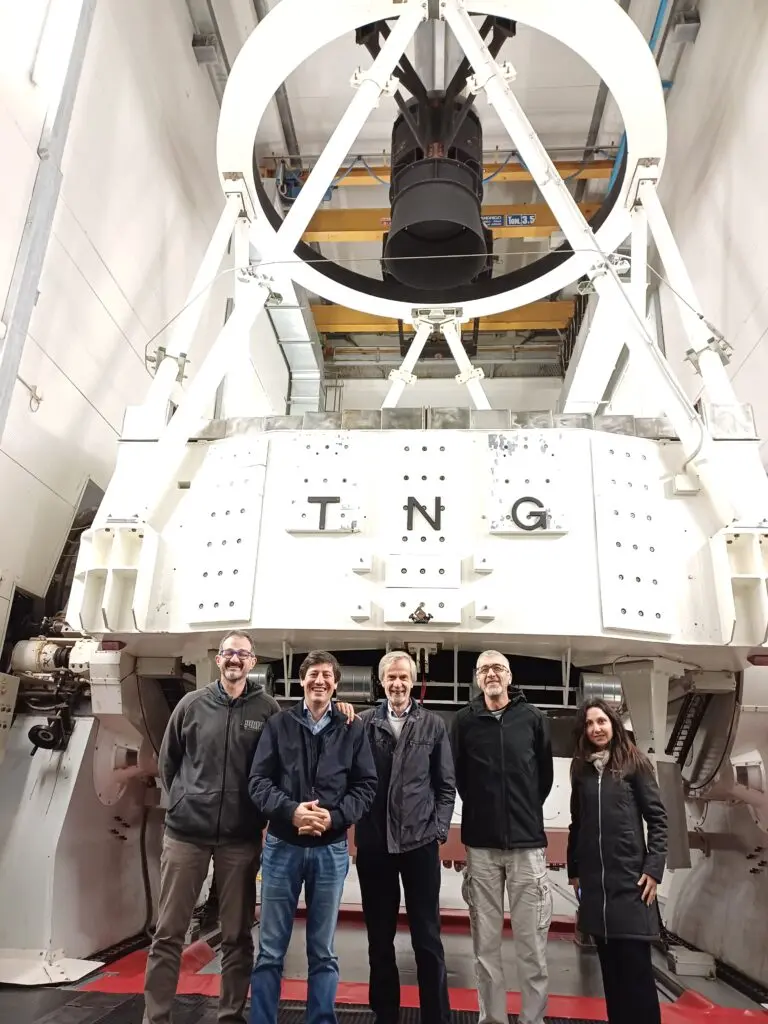
The “Astrocomb” research team inside the dome of the Galileo National Telescope (TNG, La Palma, Canary Islands). The primary mirror (3.6 m in diameter; weighing 6 tonnes) and the secondary mirror (black, at the top) are visible.

The role of lasers in the discovery of exoplanets

Planets do not emit their own light and do not shine with their own light, so they cannot be observed directly.

One of the most effective methods for detecting them is the radial velocity method. When a planet orbits a star, the star also undergoes a small periodic motion around the system’s centre of mass, due to their mutual gravitational attraction. If the planet’s orbit is very wide, the star’s displacement is extremely small but regular over time.

This movement produces a minuscule shift in the spectral lines of the starlight, due to the Doppler effect: if the star approaches, the frequencies of its radiation are slightly higher; if it moves away, slightly lower. These are, of course, infinitesimal variations.

For this reason, it is necessary to have a spectrograph calibration that is extremely stable over time. This is where frequency comb lasers come into play. These systems produce a series of perfectly equidistant and very stable frequencies, with accuracies of the order of one part in 10¹².

The result is a veritable “comb” of frequencies: a series of equidistant ”optical teeth” covering a broad spectral region and functioning as an optical reference ruler.

The light from the frequency comb is coupled to the astronomical spectrograph along with the light from the star. The comb acts as an extremely precise and continuous calibration system, allowing the instrument to be calibrated with a stability that was previously unthinkable.

Since observations must last for months or years to reveal the periodicity of the star’s motion, without such fine calibration the Doppler shifts would be indistinguishable. This is why laser physics has become a crucial tool in the search for exoplanets.

Why work in the near-infrared

Most of the stars in our galaxy are red dwarfs, i.e. stars that are smaller and cooler than the Sun, with very long evolutionary times — they can live for tens of billions of years — and therefore with greater potential for the development of stable planetary systems.

However, red dwarfs emit most of their radiation not in the visible spectrum but in the near-infrared. To study them, it is therefore necessary to work precisely in that spectral region.

With the laser frequency comb, it is possible to operate in this range. The system covers a very broad region of the spectrum, from around 900 nanometres up to 2.4 micrometres — spanning more than an octave — thanks in part to supercontinuum generation techniques using non-linear materials.

The system has been designed to be coupled with the GIANO-B infrared spectrograph, installed at the Galileo National Telescope on La Palma, in the Canary Islands. The comb has been designed to cover the entire spectral range of GIANO-B and to serve as an extremely precise and stable calibration system over time.

The system is currently undergoing validation in the laboratories of the Politecnico di Milano, but the aim is to transfer it to the telescope by the end of the year and have it operational in 2027.

Other areas of research where this technology can be applied

The system can be used to study stellar atmospheres or to verify the stability over time of certain fundamental physical constants.

Furthermore, optical combs have potential applications in optical communications: thousands of spectral lines mean thousands of transmission channels available in parallel.

A word of advice for young researchers

For those wishing to pursue a career in science, passion is essential. Research can be deeply rewarding, but it also involves difficult moments, especially in a highly competitive international environment.

This is why it is important to choose a field that truly inspires you and to build up solid expertise over time. At the same time, you must keep an open and curious mind: the most interesting innovations often arise from the intersection of different disciplines.

The NIR AstroComb project is a case in point: laser physics has met astrophysics, opening up new perspectives for the exploration of the cosmos.

Share on: