Caterina Amendola and Comics&Science: research becomes a comic

You’ve contributed to the new edition of Comics&Science. How did this collaboration come about and how did the work develop?

The collaboration came about as part of the I-PHOQS project. The research group working on scientific communication was looking for people who could help create a comic that would explain the different areas of physics involved in the project. As soon as I heard about the initiative, I threw myself into it head over heels! Each of us brought a piece of our own research field, working together to find a way to turn it into an accessible and engaging story. It was also a wonderful exercise in collaboration: a sort of team-building exercise, but with photons, ideas and comics.

Was this your first experience of writing a comic? What was it like to grapple with a language so different from that of scientific research?

Yes, it was the first time I’d tried my hand at writing a comic. I’d already had some experience in science communication, for example through workshops in schools and activities aimed at children and young people under the age of thirteen, during events such as the Engineering Festival or International Day of Light.

Writing a story, however, is something quite different.

You have to simplify the language without trivialising it, leave room for imagination without letting it take over and, above all, avoid scientific inaccuracies. It was challenging, but also great fun: it forces you to look at what you study every day from a completely new perspective.

Were you already familiar with the Comics&Science project? What struck you about this way of communicating science?

I was familiar with a few editions (such as the one written by Zerocalcare). As I mentioned earlier, I find that this way of explaining what we do in the laboratories is very complex, but at the same time it makes what happens inside the laboratories seem even more magical. It transforms science into an adventure, and turns everyday challenges into something almost poetic.

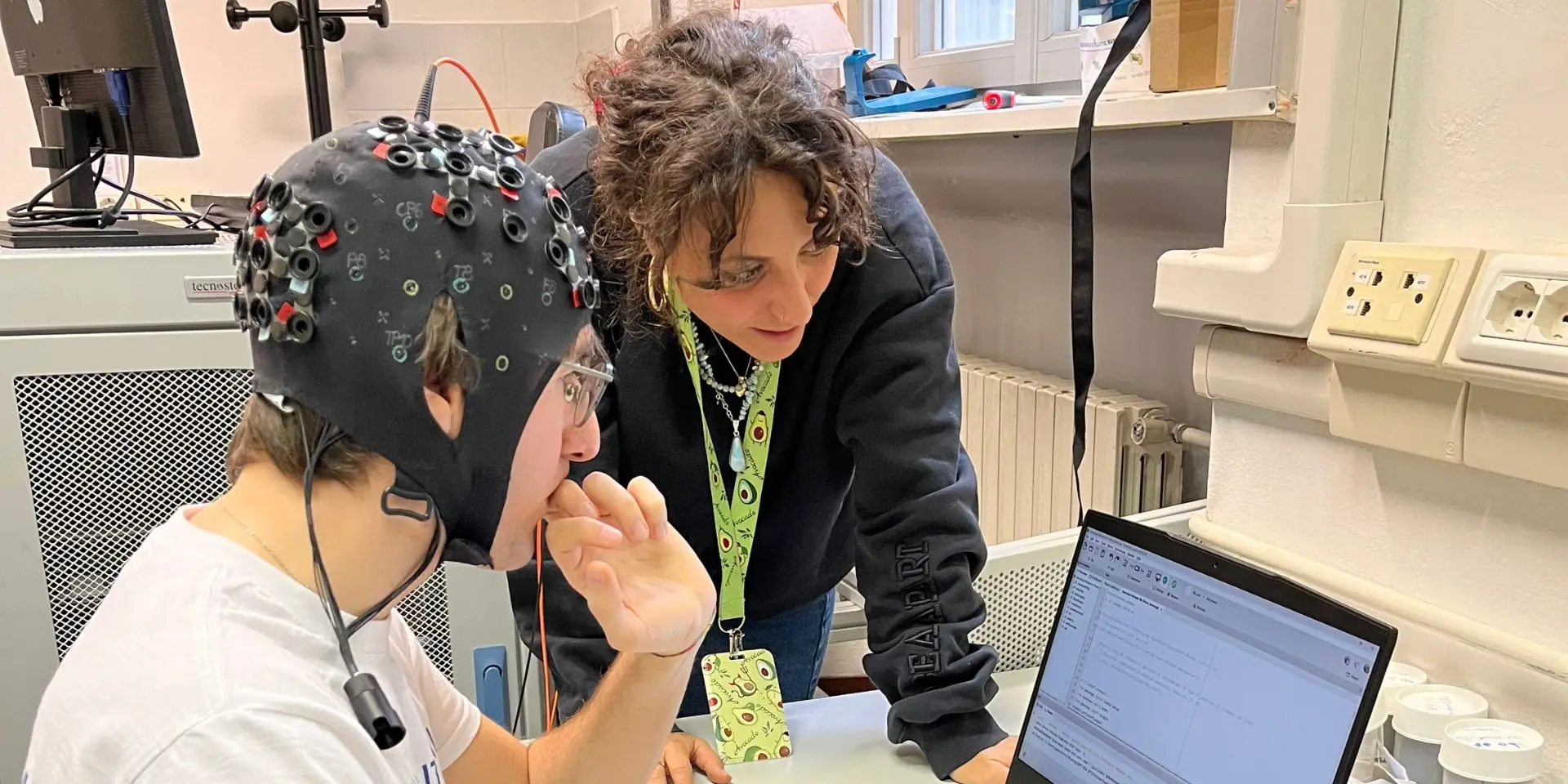
Caterina Amendola, a researcher in the Department of Physics

The protagonist of your story is Lumi, a photon that embarks on a journey through the brain. How did the idea for this character and the accompanying story come about?

The idea for Lumi stems from a central concept of our work: we measure individual photons which, after passing through tissue, reach the detector at different times. We cannot directly track the path of each photon, but by statistically analysing their arrival times, we can glean information about what happened whilst the light was propagating through the tissues.

Lumi therefore represents the journey of light through the brain: a path constantly altered by phenomena such as absorption and scattering – that is, deviations caused by interactions with biological structures. Through its adventure, we have sought to explain in simple terms how the optical properties of tissues influence the path of photons and ultimately enable us to gain insights into the brain.

My imagination for this story was inspired by the afternoons I spent as a child with my best friend Enrico – now a cartoonist – when we used to make up adventurous journeys involving rivers, steep climbs and unlikely obstacles.

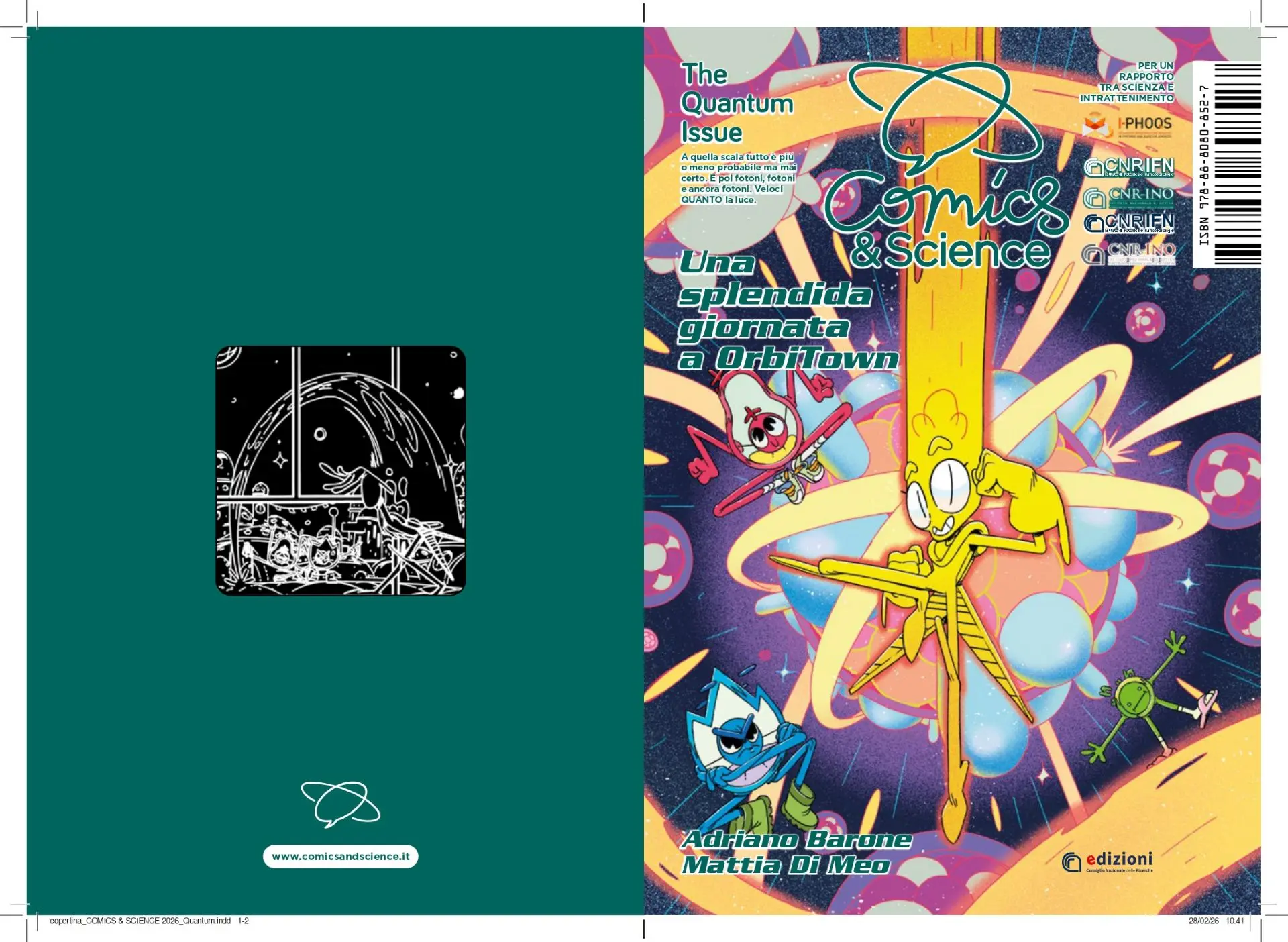
Cover of the Comics&Science comic, 2026 edition

Do you think comics can be an effective tool for introducing the public – especially younger people – to scientific research?

Definitely. For many people, comics can be a more immediate, engaging and less intimidating form of communication than an article or a traditional lecture. They can spark curiosity, raise questions and perhaps encourage someone to explore the subject further.

And it’s not just for children: adults, too, can be captivated by a well-told story.

Is there any aspect of Lumi’s story or character that you’re particularly fond of?

What I liked most was being able to transform absorption – which, from a scientific point of view, represents the ‘loss’ of a photon – into something beautiful and poetic.

Normally, absorption is imagined as something that sucks in or makes light disappear. In the story, however, it becomes a gesture of love and affection: a sweet conclusion, almost a happy ending.

Share on: