
TOMATTO
Website's ProjectTOMATTO
Website's Project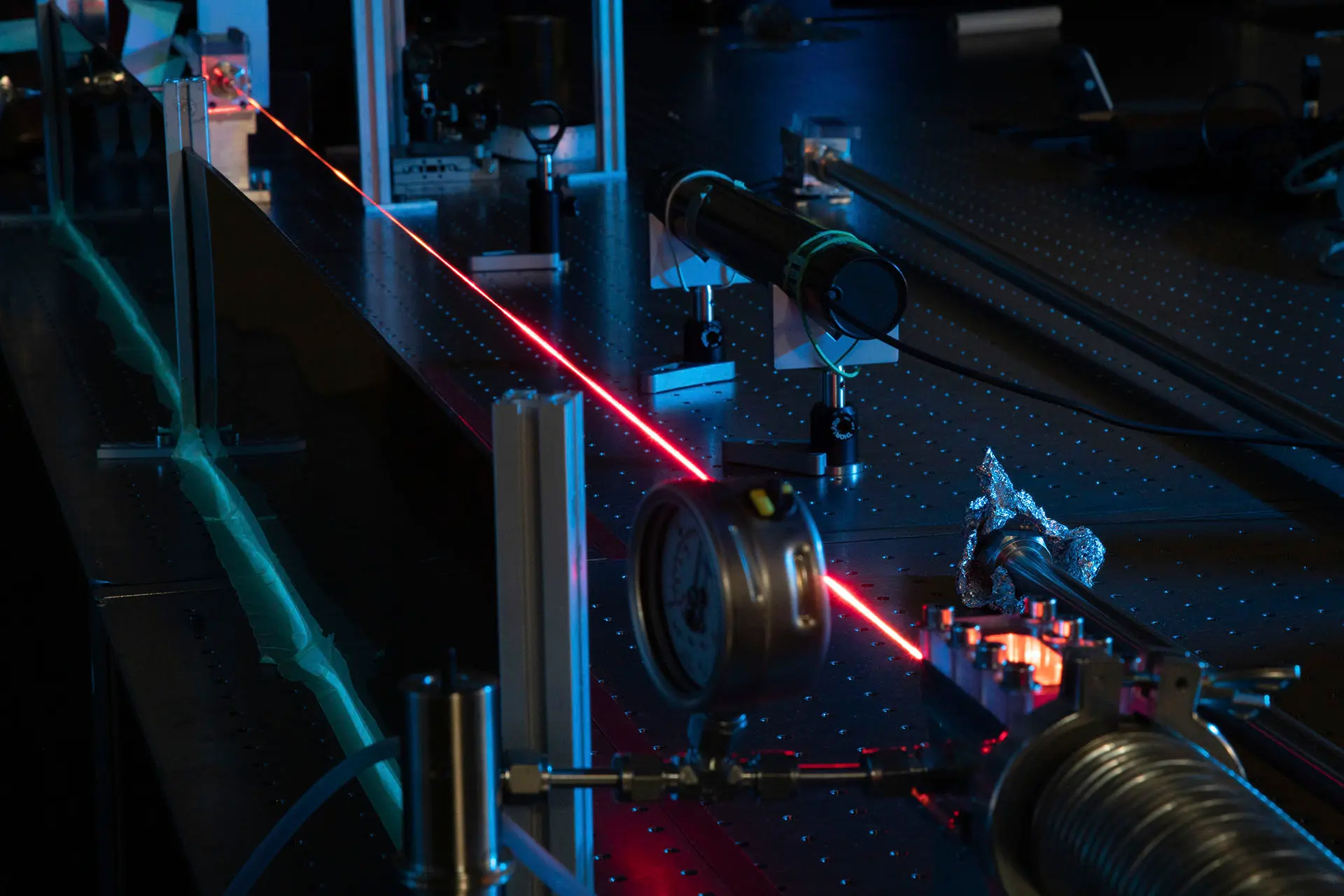
The goal of the laboratory is the generation and application of attosecond pulses to ultrafast molecular dynamics.
The laboratory, originally realized under the ERC (European Research Council) Advanced Grant “ELYCHE” (Electron-scale dynamics in chemistry), is currently funded by the ERC Synergy Grant “TOMATTO” (The ultimate time scale in organic molecular opto-electronics, the attosecond).
The main research directions are the following:
- Organic optoelectronic materials: study and coherent control of the electron dynamics and photo-induced charge transfer processes in molecular materials with high interest for optoelectronic applications, such as photovoltaic devices, molecular wires, artificial photosynthesis.
- Attochemistry: study of the interaction of light with polyatomic molecular systems by triggering ultrafast electronic motions, with the goal of controlling the chemical properties of molecules through a time-resolved manipulation of the electronic degrees of freedom.
- Ultrafast processes in bio-relevant molecules: study of the electron dynamics in biomolecules like amino acids or DNA bases. The main research focus is the understanding of the elementary processes which play a fundamental role in many relevant biological mechanisms, e.g. photodamage and the transmission of bio-signals in proteins and DNA.
Website: http://www.attosecond.fisi.polimi.it
Laser Source
The driving source is a Ti:Sapphire amplified laser system which generates 25 fs pulses with an energy of 10 mJ, repetition rate of 1 kHz and stabilized carrier envelope phase (Coherent Legend Elite DUO). The radiation can be converted from 800 nm to the 1 – 2.5 um range thanks to a High-Energy Optical Parametric Amplifier (Light Conversion TOPAS HE PRIME), allowing for ponderomotive scaling of HHG.
A portion of the laser beam is post-compressed by using the hollow fiber technique in combination with ultrabroadband chirped mirrors down to 4 fs (1.5 optical cycles) with an energy of 1.5 mJ. The spectrum covers the entire visible (VIS) range, extending in the near-infrared (NIR) up to 1000 nm.
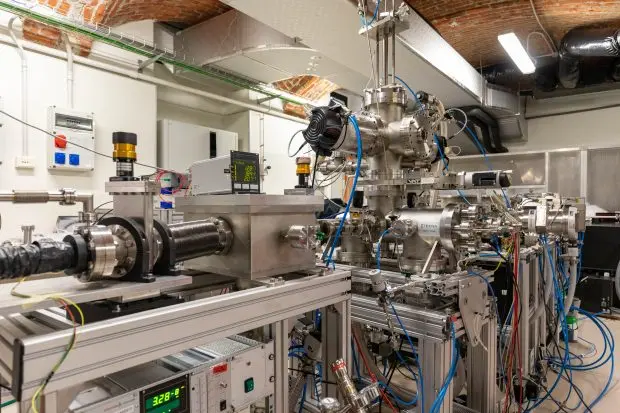
Attosecond Beamline
The 1.5 mJ 4 fs pulses centered at 800 nm are the seed of the attosecond beamline. A fraction of the beam is used for generating Extreme UltraViolet (EUV) radiation through High Order Harmonic generation (HHG). Recombination of the residual 4 fs beam with the generated EUV in an actively-stabilized interferometer enables VIS/NIR – EUV attosecond spectroscopy and metrology. In particular, temporal characterization of the EUV pulses generated in Argon is achieved by Attosecond Streaking in an Argon gas target: the resulting pulse duration is as short as 180 as (FWHM).
We extend the excitation wavelength range at our avail to the ultraviolet (UV) via Resonant Dispersive Wave (RDW) emission, a nonlinear process allowing to obtain few-fs pulses with tuneable central wavelength from Deep UV (200 nm – 300 nm) to UV (300 nm – 400 nm) and high efficiency. RDW in gas-filled HCFs allows us to resonantly address specific molecular excitations in the systems under investigation while preserving the high temporal resolution of the experiment.
Currently, the main experiment consists of gas-phase UV pump/EUV probe Time Resolved PhotoElectron Spectroscopy (TRPES) of organic compounds. The overall temporal resolution of the experiment, 3 fs, is beyond the state of the art.
Research projects
ATTHALO
Find out moreTOMATTO
Find out more